
The idea is to incorporate global best practices in the Indian context.
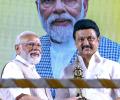
On one hand, South Indian states have been complaining about denial of a proportionate portion of the sharable funds from the Centre, based on population. On the other hand, they stand to lose Lok Sabha and Rajya Sabha seats that again are based on population, points out N Sathiya Moorthy.
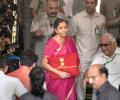
'The household sector, which is still the largest contributor of financial savings, has been experiencing a decline in the last six years, and it has fallen below 8% of GDP.'
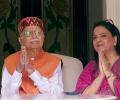
Most politicians and even non-politicians have been honoured because of what they were purported to be electorally worth for the ruling party of their time, argues N Sathiya Moorthy.
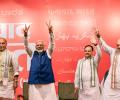
'Commentators have said that dealing with allies as equals will make Modi more sensitive.' 'Remember that the people Modi is dealing with are equally autocratic in their own lairs.' 'Further, Modi always has handy the threat of dissolving Parliament and calling for fresh polls.' 'Most of his own party, and certainly his allies and opponents having blown their budgets of efforts and resources in the just concluded elections, have no stomach for this.' 'They are all greatly looking forward to the loaves and fishes of office on offer.' 'That gives Modi an unbeatable advantage in any push-comes-to-shove situation,' explains Shreekant Sambrani.

Earlier this week, Bihar Chief Minister Nitish Kumar said a law on population control would not serve any purpose but insisted instead on education for girls and women.
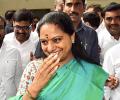
'He is exposing the failings of the BJP, which is rankling the party.'

A new entrant, whether a popular actor or not, has not been able to sweep the polls, as their fans had hoped for. Given a proven pattern, it should hold true for Vijay as well. Or, something drastically has to happen between now and 2026, asserts N Sathiya Moorthy.

There have been media reports of Banerjee meeting Rahul Gandhi at his residence in New Delhi on Wednesday morning. A leading Bengali daily had reported the meeting.
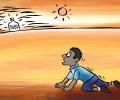
The country's demographic dividend is dissipating, with seriously adverse consequences for young India, asserts Shankar Acharya, former Chief Economic Adviser to the Government of India.

'It is only for a particular kind of Indian. The thing is: Even some of those types of Indians do not like it,' says Aakar Patel.

The Appointments Committee of Cabinet has named Ravneet Kaur, a Punjab cadre IAS officer of 1988 batch, as chairperson of the Competition Commission of India (CCI). Kaur will hold the post for five years or until attaining the age of 65. She is the second woman to serve in an 'economic regulator' role after Madhabi Puri Buch, who was appointed chairperson of the Securities and Exchange Board of India last year and the first woman to head the country's chief national competition regulator.
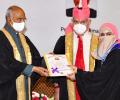
"Democracy, I firmly believe, has within it the capacity to reconcile all differences and also the capacity to bring out the best of the citizens' potential. Kashmir, happily, is already realising this vision," the President said in his convocation address at the Kashmir University in Srinagar.
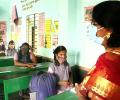
'There are large cohorts of students who cannot recognise the alphabet or numbers.' 'We are suggesting schools 'start early and end late'.'

'Everybody says 5G and communication is important.' 'Everybody says automation, robotics, human computing interfaces -- people and machines working together -- is the future.' 'Everybody agrees that cybersecurity is something that is here to stay.' 'Everybody agrees that synthetic biology is important.' 'Instead of outlining thinking about industries for tomorrow and the future, let the evolutionary pathway be built in a way that it promotes robust, creative, thinking.'
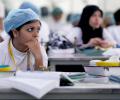
Medical seats for under-graduates and post-graduates remaining vacant in the NEET era, together with the Centre 'freezing' the number of medical colleges and seats in (Dravidian) Tamil Nadu and the launch of the PM's 'Vishwakarma Scheme' for the nation's craftsmen, are all seen as a bid to further reverse the state's progressive socio-economic agenda of and its achievements of the past hundred-plus years, argues N Sathiya Moorthy.

Besides low interest rates, a reduction in active Covid cases and strong high-frequency macro data have lifted the sentiment of both corporate India and the stock markets.

New foreign trade policy to stress manufacturing exports.

Does IAS officers' work go unappreciated, asks Ajit Balakrishnan.

A total of 415 million people moved out of poverty in India within just 15 years from 2005/2006 to 2019/2021, the United Nations said on Tuesday, highlighting the remarkable achievement by the world's most populous nation.

There will be a lot to repair and rejuvenate -- if that opportunity even presents itself, warns Rathin Roy.
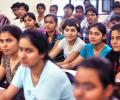
The nine-page guidelines have been issued days after the state government set up a 15-member committee headed by education secretary Bhawani Singh Detha to examine the issue after record student suicides were reported from coaching hub Kota.

'There are many things we need to work on.' 'At the heart of it is, one, the extent of inequality, which is not good for democracy and nation; two, a structural decline on how a country ought to function, how people should be held accountable, whose role is what.'
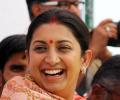
Taking on her critics, Human Resource Development Minister Smriti Irani on Sunday dismissed charges that education was being saffronised even as she turned down demands that Sanskrit be made compulsory in the curriculum.

The federal probe agency also made a fresh arrest in this case as it took into custody Hyderabad-based liquor businessman Arun Ramchandra Pillai, they said.

India on Tuesday told the UN General Assembly that the days when a few nations set the agenda and expected others to fall in line are over, underlining that its presidency of the G20 sought to focus on key concerns of the many, not just the narrow interests of a few.

For all its claims to economic glory, the majority of India's population lives vulnerable lives, a situation that has only worsened over the past 15 years, to the extent that the government now fears to release economic data or even conduct a proper Census, notes Rathin Roy.

As part of the programme, 14 states have been identified in the first phase in which there are 64 districts.

It also promised to launch the 'Poshane' scheme through which every BPL household will be provided with half litre 'Nandini' milk every day and five kg 'Shri Anna - siri dhanya' through monthly ration kits.

The 'Pesta Demokrasi' is a cause for celebration not only for Indonesia but also for democracy and forces for peace all over the globe, notes Sandeep Chakravorty, India's Ambassador to Indonesia.
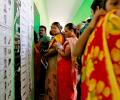
Is the unusually and unbearably scorching Sun and the general laxity, bordering on laziness, among voters, responsible, asks N Sathiya Moorthy.
With the arrest of Deputy Chief Minister Manish Sisodia in the excise policy scam case, uncertainty looms over several critical Delhi government projects, including streetscaping and traffic decongestion plans, ahead of the G20 summit.
The BJP-led Centre sent the CBI to conduct searches at Deputy Chief Minister Manish Sisodia's residence here just after the New York Times published a positive story in its front page about the Delhi model of education, AAP leaders said.

Human Development -- a measure of a nation's health, education, and average income -- has declined for two years in a row.

While the responses of the candidates were predictable, depending on which side they belonged to, an interesting point slipped through when Rahul Shewale cited the Dharavi Redevelopment Project as a scheme that would add to Mumbai's importance. No big infrastructural project in Mumbai, he said, could be successful without the Centre's nod.

ISB professor Tarun Jain talks to Shobha Warrier/Rediff.com about what the government must do to achieve 8 pc growth.

... Are far-reaching social changes coming with it, asks Ajit Balakrishnan.

Panel chairman Thakur is believed to have informed Dev that the issue was not on the agenda for the meeting.

Debates on changing the name of India to Bharat continue to spark a crisis of identity without answering moot questions that stare us in the face. Ramesh Menon asks a few of those questions that do not have easy answers.
As the petition points out, new medical colleges entail adjunct government hospitals, thus making specialised medical care that much more accessible to the vast majority of population that otherwise could not afford high-cost medical care in the private sector, N Sathiya Moorthy points out.
